


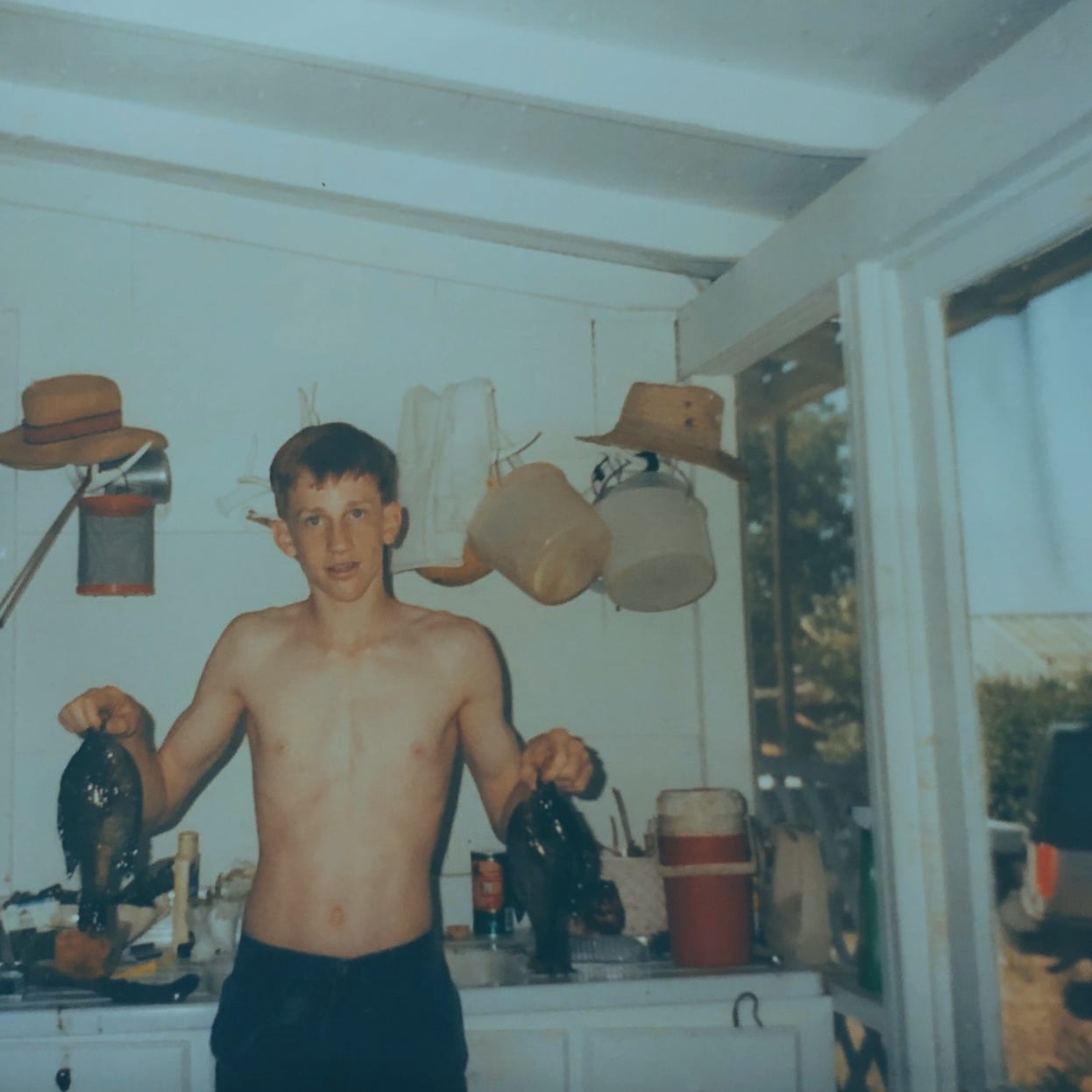
It’s a Friday in the thick of a southern summer. You know where to find Arthur Alligood.
He’s somewhere fishing, looking for the living things just beneath the surface.
It might be a bass, tucked under a log at the edge of the pond. Perhaps it’s one of the shiny and invasive bream — “brim,” Alligood pronounces it, stretching the boundaries of how short a syllable can be with his thick Tennessean accent.
It may take a while to get a bite, but all is good for Alligood. He’s happy to sit at the edge of the pond, curious, creative and cramping.
When he finds what he’s looking for, he’ll pluck it and hold it proudly. Alligood will probably slip a knowing grin, like his teenage self does on the cover art for his new album under the name phoneswithchords, High Up On The Wheel Well.
It’s a record about fishing. More precisely, it’s an album about southern summers and the wonder of youth.
“To me,” he says, “it’s all fishing.”
High Up On The Wheel Well is a scrapbook collection of memories from the Junes and Julys of his childhood. It’s the album Alligood has been writing his whole life. It just took him a while to get there.
The 47-year-old singer, songwriter, father and free-time fisherman has been thinking a lot about aging lately. He now has one living grandparent. His oldest daughter is about to graduate nursing school. And his youngest daughters, twins, are about to enter their senior year of high school.
“You’re constantly building, being a parent, toward your kids leaving,” Alligood said.
And now, on the precipice of that moment, he’s found himself running to the memories of his own Tennessee childhood.
Brainspotting
This process started in therapy, where he’s began experimenting with the psychotherapy technique called brainspotting. It’s a memory-based process that involves using eye recognition to pinpoint where certain memories come from. Through that process, he’s noticed a theme.
“All the moments I really grew as a boy, whether they were tough moments or beautiful moments,” Alligood said. “They all take place during the summer.”
So naturally, as a songwriter who has been making music for more than two decades now, he wrote an album about it. High Up On The Wheel Well is remarkably lush, with just over 50 minutes of pure, humid serenity. He’s not always grasping for deep meaning, but instead processing these memories in real time. It’s the album equivalent of flipping through old pictures, teleporting to those places for brief moments and then turning the page.
Perhaps most noticeably, the album itself moves like a school-aged summer. You know when you’re young, and the hottest months swing back and forth between trance-like leisure and vacation-induced exuberance? There’s a constant crescendo and decrescendo to the summer months.
Same goes for High Up On The Wheel Well.
It arrives quietly, starting literally from Alligood’s birth on “Born.” The gentle, plucky guitars of the opener slip you into a May tranquility before bursting into solar flares.
“Born to discover,” he concludes over explosive, cinematic percussion and whirring guitars. “To find out what’s underneath.”
High Up On The Wheel Well drops you straight into Alligood’s most vivid memories, many of which take place on the road. He is always heading somewhere — taking the freeway to Chattanooga’s Nickajack Lake, driving through the Ponder Woods, curling into a cannonball in the pool of a KOA campground, sharing a bed with his brother as semitrucks pass outside his grandmother’s house.
This is a certified road trip record. There’s literally a song named after the I-75 S, where Alligood introduces the central question of High Up:
What is it about the memories?
What is it about your history?
Stumbling through the dark
Trying to find your way back
All the way to the start
The images are even more vivid in the album’s accompanying short film, released on Thursday. Fittingly, about half of the runtime is on the road, packed with the camcorder charm of a family attic’s found footage.
‘I felt the day in my arms’
Alligood has described finding his way back to youth as an out-of-body experience.
In therapy, there’s one memory he comes back to more than any other. It’s the story he tells on the title track.
The memory looks like this in his mind: A preteen Alligood is sitting on the wheel well in the bed of his late grandfather’s rusty, green Chevy pickup truck. His family baled hay on the farm that day, while he and the other kids played.
They played, and played, and played.
“I felt the day in my arms,” he said. “It was that good kind of ache you get when you’ve been doing something physical.
“It was the first time I remember being conscious in my own body. I’d always been a kid that was inside my head, but that was one of the moments where I was like ‘Oh, I have arms. I have legs.’”
Going back to these memories isn’t always so easy. The hardest part of writing about growing up is confronting the parts of you that have changed.
Prior to launching his phoneswithchords moniker in 2021, Alligood took a several-year hiatus from releasing music. Before that, he had a career as a songwriter making Christian music. In the last five to ten years, he’s grown apart from the church entirely.
But a true reflection of Alligood’s youth would be incomplete without faith.
There were Vacation Bible School camps and rhythmic Sundays, fenceposts in the sand of an otherwise blurry summer. He and his brother sat through sermons and pretended to understand. They’d play under the trees as the adults shot the breeze on the porch.
He only really goes there once, on the empathetic B-side “Summer Sundays”:
We were always hearing of David
How he took down Goliath with a stone
But we were stuck in that room
He tried to explore Christianity more often while writing songs for this record, but it threatened to hijack the entire narrative, he said.
“Maybe I’ll unpack all this faith stuff in another album,” Alligood said. “But it would’ve just toppled the album if I tried to.”
“I didn’t want it to be critical, in the sense that I have tons of issues with the church now. But back then, it was this pure thing that was happening from my experience.”
‘I didn’t want it to feel like country music’
The album is mixed, mastered and co-produced by Nick Webber of Denver band A Place For Owls.
For those who have heard Webber’s work with the Owls, or his beautifully autumnal solo record All The Nothing I Know, you can see his fingerprints all over this phoneswithchords album’s most delicate moments.
“Nick has become, essentially, a little brother from another mother,” Alligood said. “He’s just the sweetest, loveliest dude.”
The two met years ago through a mutual love for each other’s work. They bonded sharing stories of childhood — Webber’s in rural Montana, Alligood’s in farm-town Tennessee.
The first song they worked on together for this project was “Winter in June,” the penultimate track on the album but the de facto closer before an instrumental conclusion. It’s a beautiful storytelling song that takes you deep into a hailstorm. Webber understood.
“He really, from the beginning, got what I was trying to do,” he said.
To channel that Southern summer sound, Alligood said he didn’t want to lean on the crutch of country music. There’s no slide guitar on this record, no Nashville twang. Instead, he retreated to the warm textures of his own coming-of-age soundtrack: early emo.
“I didn’t want it to feel like country music,” he said. “I wanted it to feel more imaginative, taking elements of that and the music of my musical upbringing.”
Major touchpoints of Alligood’s adolescence include Sunny Day Real Estate, The Appleseed Cast and Mineral, whose EndSerenading record was one of the album’s biggest influences.
You have to squint a bit to see the emo influence, but it’s there. His voice never quite boils to a scream, but there’s still catharsis in his pensive whisper. The dynamics feel more rooted in lo-fi indie rock, but the guitars are echoing and plucky.
‘A lifetime in the making’
Perhaps the most emo-indebted song on the record is the climactic centerpiece “Summer of ‘91 (America).” Unlike the humble vignettes of songs like “Winter in June” or “Median,” “Summer” has a backstory straight out of a movie.
The story goes like this: Alligood’s father is a career journalist who worked for many years at The Nashville Banner. (Perhaps that’s where his son got the knack for narrative.)
It was at the Banner, in the summer of 1991, that his father pitched a bold idea to his editor: The Alligood family would travel the nation, take in every slice of Americana and assemble an epic, two-month odyssey of the perfect family summer.
And it really happened. They visited Yellowstone and Mount Rushmore, rode roller coasters at Cedar Point, toured monuments in D.C., flew over the Grand Canyon and hiked through Glacier National Park.
The trip is the most crystal clear of all the murky memories floating in Alligood’s pond.
He remembers the road, the sights, the disorienting feeling of getting home when it was all over. He can still picture his dad stopping at a gas station payphone to call in the next chapter of the saga to his editor.
It’s all immortalized in print — and now on a phoneswithchords album, too.
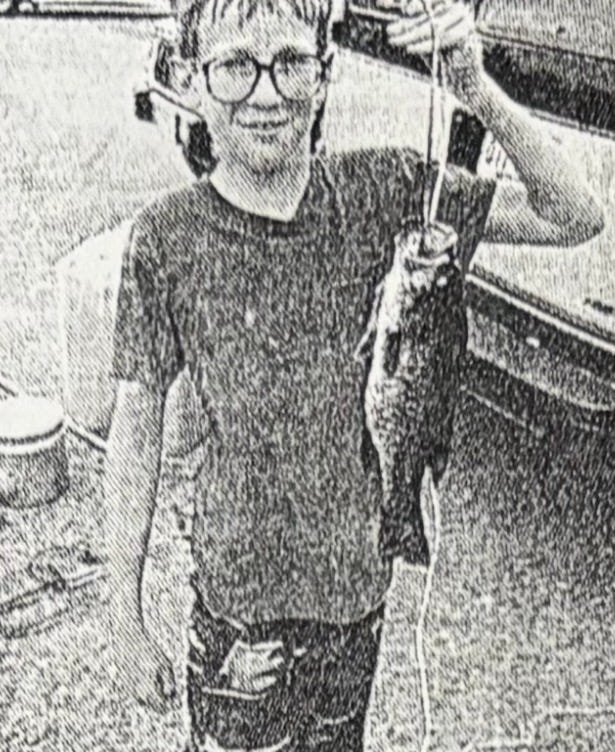
It was this trip that shaped Alligood more than any other experience in his life, he says.
The triumph of it comes to life on the song. It’s a buoyant, explosive moment in the middle of the record that runs kaleidoscopically from highway to highway, landmark to landmark. It ends with a fuzzy rendition of the national anthem.
“That song, more than any song I’ve ever written, has been a lifetime in the making,” Alligood said.
But it was a struggle to write. He questioned whether or not he should even release it, fearing it might sound too patriotic and dismissive of the many ills of American nationalism.
“I just was really scared it was going to be too ‘home of the brave!’” he said. “Just really myopic and not acknowledging the real harm of this country.”
But he sent it to friends and took in feedback. Ultimately, he rides the line gently, giving the song an appropriately ambiguous denouement.
America, America
I think I saw your heart
I think I saw your heart
Still looking for your heart
Like “Summer Sundays,” in order to confront the incongruity of then and now, Alligood put himself in the headspace of a boy, young enough to still believe in war and wonder. He chose to include “Summer of ‘91” as an ode to his parents and the sheer audacity of the road trip idea. They love it.
“My dad’s been supportive of my music my whole life,” he said. “But I could really tell he was so proud I wrote that song.”
He holds onto the newspaper clippings of that trip as treasure now. Reading through them, it’s startling to see the parallels in Alligood’s fatherhood and his own dad’s in 1991. Alligood’s father explains in the piece that this trip was intended as a last hoorah of their sons’ adolescence.
“Before Bertie and I know it, we’ll be empty nesters,” he wrote for the Banner 35 years ago this month. “To Arthur, we are no longer mama and daddy. Now he calls us mom and dad, a change that, I suspect, portends more than a simple change in semantics.”
High Up On The Wheel Well brings those names back a half-dozen times. The 47-year-old Alligood is seeing through those pre-teen glasses once again.
It’s his own odyssey, a way to memorialize the life that led him to this one.
“These songs felt like monuments,” he said. “I just wanted to put a stone in the ground for [each] moment, and then it’s just there.
“I feel like this will be a gift to, maybe, my grandkids. It’s really special to me.”
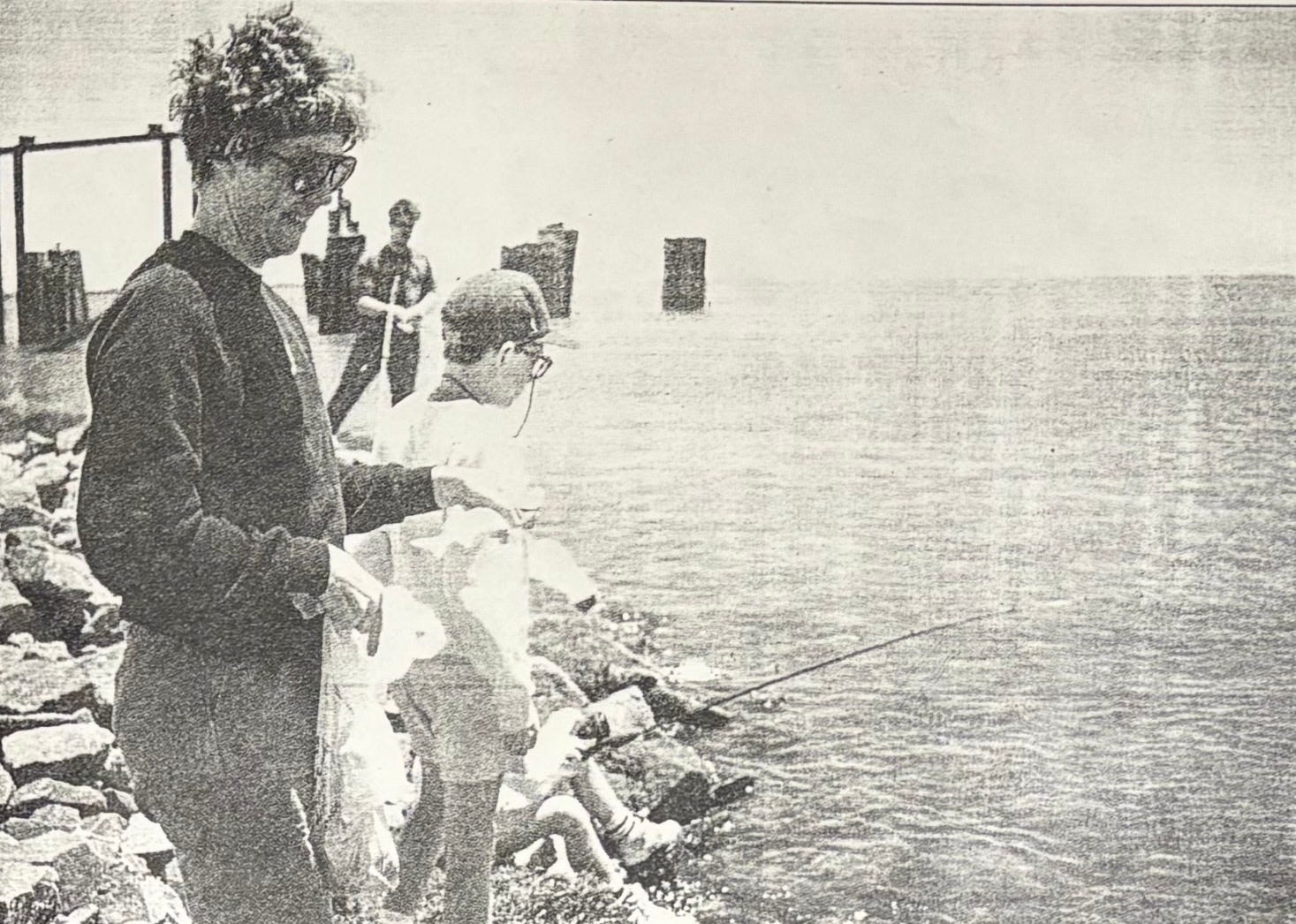
Of course, in almost all the photos from that cross-country vacation, Alligood is fishing. He’s always been fishing.
Alligood talks about fishing like one might talk about God. Some of the most “holy” moments of his life were spent by the pond, Alligood says. In those forever summers, he used to catch fish to cook ‘em for dinner.
He catches and releases now. The impermanence makes it even sweeter.
“It’s this brief encounter with this beautiful thing,” he says. “I get a moment to be with it, and I hold it in my hands for a little bit, then let it swim back to its home.”
i checked this album out because of your post and it was stunning, so thank you!!!